
With its long history of producing high-quality, affordable cars for the average joe, Toyota is taking the opportunity to reintroduce the Toyota Supra, just in time to throw down the gauntlet to the new BMW Z4. But how does the new suped-up Supra compare with old faithfuls like the Toyota Yaris and the Toyota Hilux?
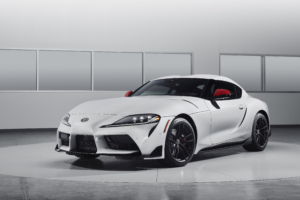
Toyota Supra: Old New Kid On The Block
The Toyota Supra first made its mark in 1979 and cycled through four generations of the model before sales slowed down in the 1990s. Movies like 2001’s The Fast And The Furious did a great job of preserving the Supra’s status as an automotive icon, but later teaser models struggled to get out of the auto show circuit and into the car dealership – until now. Despite the decline in sales, the love is still there, so it’s no surprise that the Toyota Supra is making a comeback to a great deal of fanfare.
Toyota’s new GR Supra made its debut at the 2019 Detroit Auto Show and is finally hitting South African dealerships. All good things come in threes, so we can look forward to three iterations of the fourth-generation Toyota Supra: the GR Supra “Track” model, the standard GR Supra, and the Matte Grey edition. All three of these are rolling out on 19-inch alloy wheels, run on a 3.0L Turbo engine, and a design that may be slightly reminiscent of the BMW Z4 (which shouldn’t be too surprising given the close collaboration with the German luxury car giant).
That said, the main differences can be found in the cabin spec. The interior of the base model already boasts dual-zone climate control, a 10-speaker touchscreen sound system, reverse camera, cruise control, and regular cloth seats. The other two suped-up Supras sport electrically-adjustable and heated Alcantara-upholstered seats, Park Distance Control, Lane Keeping System, Pre-Crash System, and a 12-speaker JBL infotainment system with satellite navigation.
However, the downside to this revived Toyota superstar may be the price tag. The standard GR Supra Track starts at R953,000, while the standard GR Supra will easily set you back by R1,072,300 and the Matte Grey edition about R1,092,300. Nevertheless, you’ll probably find it may be worth it, given Toyota’s track record for safe, sustainable cars. The verdict from motorheads and Toyota fans alike is: it was worth the wait!
Toyota Yaris: Taking On The City
The self-proclaimed “ultimate urban hatchback” certainly lives up to its name, and, given the number of Yaris’s you see on the streets of Johannesburg, Durban, and Cape Town (among others), it’s clear that many South Africans would agree. The new Toyota Yaris is a bit bigger, having grown by 165mm in length and 5mm in width. This translates into a larger luggage capacity (8% increase to 310 litres) and an increase in cabin space.
The new Yaris range features four models, which are powered by the same engine: a 1.5-litre, 4-cylinder petrol that offers up 79 kW and 140 Nm. You can choose between a 5-speed manual gearbox or a Continuously Variable Transmission (CVT) to drive the front wheels. Fuel consumption is claimed to be 5.9 L/100km and 5.8 L/100km, for the manual and CVT respectively.
The Yaris models on offer in this range are the Xi, Xs, Cross, and Sport, with each sporting unique features of their own:
The Toyota Yaris Xi features include keyless entry, push-button start, 4-speaker audio system with USB and Bluetooth functionality, multi-information display, electrically adjustable exterior mirrors, front power windows, electric power steering, and manual air-conditioning. The Yaris Xs has the same features as the Xi with the added bonus of automatic lights, 16-inch alloy wheels, retractable exterior mirrors, rear power windows, leather steering wheel and gear knob, steering switches, and LED daytime running lights.
The Cross takes it one step further by throwing in roof rails, black side moulding, brushed metal apron treatment (front and rear), and black over fenders. Sitting at the top of the range is the Sport model, which features a red-stitched leather steering wheel and gear knob, 2 additional speakers (for a grand total of 6), high-definition “Optitron” instruments, leather seats, climate control air conditioning, front fog lamps, projector headlamps, LED rear taillights, rear boot spoiler, shark-fin antenna, side skirts, front and rear spoilers, dark metallic front grille, projector headlamps, and a red accent pipe.
Two ways in which the Yaris has stepped up is in its touchscreen infotainment system and its many safety features. Aside from the standard FM/AM radio set-up, and USB and Bluetooth connectivity, the real highlight is this system’s full smartphone integration and support with Apple CarPlay and Android Auto. All models of the new Toyota Yaris is also fully equipped with driver and passenger airbags, ISOFIX points, ABS with Electronic Brake-force Distribution (EBD), Brake Assist (BA), Vehicle Stability Control (VSC), seatbelt pre-tensioner and force limiters as well as Hill Assist Control (HAC).
This is a city-slick hatchback you can count on with features that make driving it a pleasure and a price tag that suits most pockets, starting from R246,400.
Toyota Hilux: My Oom se Motor… And Mine Too
The Hilux has been the Toyota 4×4 of choice for many South Africans and now we can look forward to its most recent incarnation, the Toyota Hilux Legend 50. This Hilux marks 50 years of Toyota’s bestselling 4×4 and is available in three body styles: single cab, xtra cab and double cab.
After having sold over a million units over the last 50 years, it’s no surprise that Toyota giving 4×4 fans all they’ve ever loved about the Hilux and more: a more aggressive grille, front bumper, new alloy wheel design, a larger multimedia display, keyless entry, push-button start, black styling bar, side steps, and all the Legend 50 badges you could ask for. Toyota has also thrown in a few additional features including LED-powered fog lights, headlights, daytime running lights, and brake lights.
Depending on which iteration of this 4×4 you buy into, you can expect one of two engines. On the one hand, you have the tried-and-tested 2.8-litre GD-6, which serves up 130 kW and 450 Nm. This engine is meant to be the more frugal of the two, with consumption figures of 7.6 L/100 km and 8.5 L/100 km for the manual or automatic respectively. On the other hand, your second engine choice is a 4.0-litre V6 for all the diehard petrol fans out there. With its 175 kW and 376 Nm, this engine is claimed to consume 11.8 L/100 km.
Naturally, the Hilux’s superior capability to manoeuvre rough terrain is what has made this Toyota a fond favourite for many South Africans, who like to take their work and their leisure off-road. The 4×4 equipped models offer drivers the range selector, which allows you to switch conveniently between 2-wheel drive, 4-wheel drive, and 4-wheel low range. For that extra peace of mind, the Hilux Legend 50 also includes downhill assist and hill-start assist.
From start to finish, front to end, this is one reliable 4×4 – well worth its price tag, starting from R401,400.
The Verdict
The Toyota Supra will definitely see another hay-day, but, compared to the prices of its mid-range relatives, that day may not be today. For convenience, safety, and affordability as well as practicality, a Yaris or Hilux will still be the more popular choice. For a flashy car with the Supra’s price tag but with more features, you might want to look at the original OG, the BMW Z4.